Design Researcher & Speculative Designer.
IMG_7908.jpg

Speculative (food) design histories

Master thesis description


Speculative (food) design histories

Speculative design / exhibition

My Master’s thesis, Speculative (food) design histories, re-imagines what the world of food could have looked like and speculates about the future of food. This project is currently on exhibit at the Cube Design Museum in Kerkrade, Netherlands.

 
Screen%2BShot%2B2018-06-29%2Bat%2B5.50.48%2BPM.jpg
 

There is a collective helplessness about the way food looks today. In this project I created alternate food realities - 3 historical and 1 in the future - to illuminate the agency we have to create a desirable future. My goal was to provoke museum visitors to reflect on their own food practices and behaviors.


Screen%252BShot%252B2018-06-29%252Bat%252B5.55.42%252BPM.jpg
Screen+Shot+2018-06-29+at+5.55.19+PM.jpg
 

The outcome of this project was four sets of artifacts, fictional stories and videos - set at four different points in time. Each artifacts suggests a world where a higher baseline understanding of science impacts food practices. The artifacts are a microbial terrarium, cellulase, blood posters and Evolufood.

All the artifacts reflect the technology and design language of their periods.
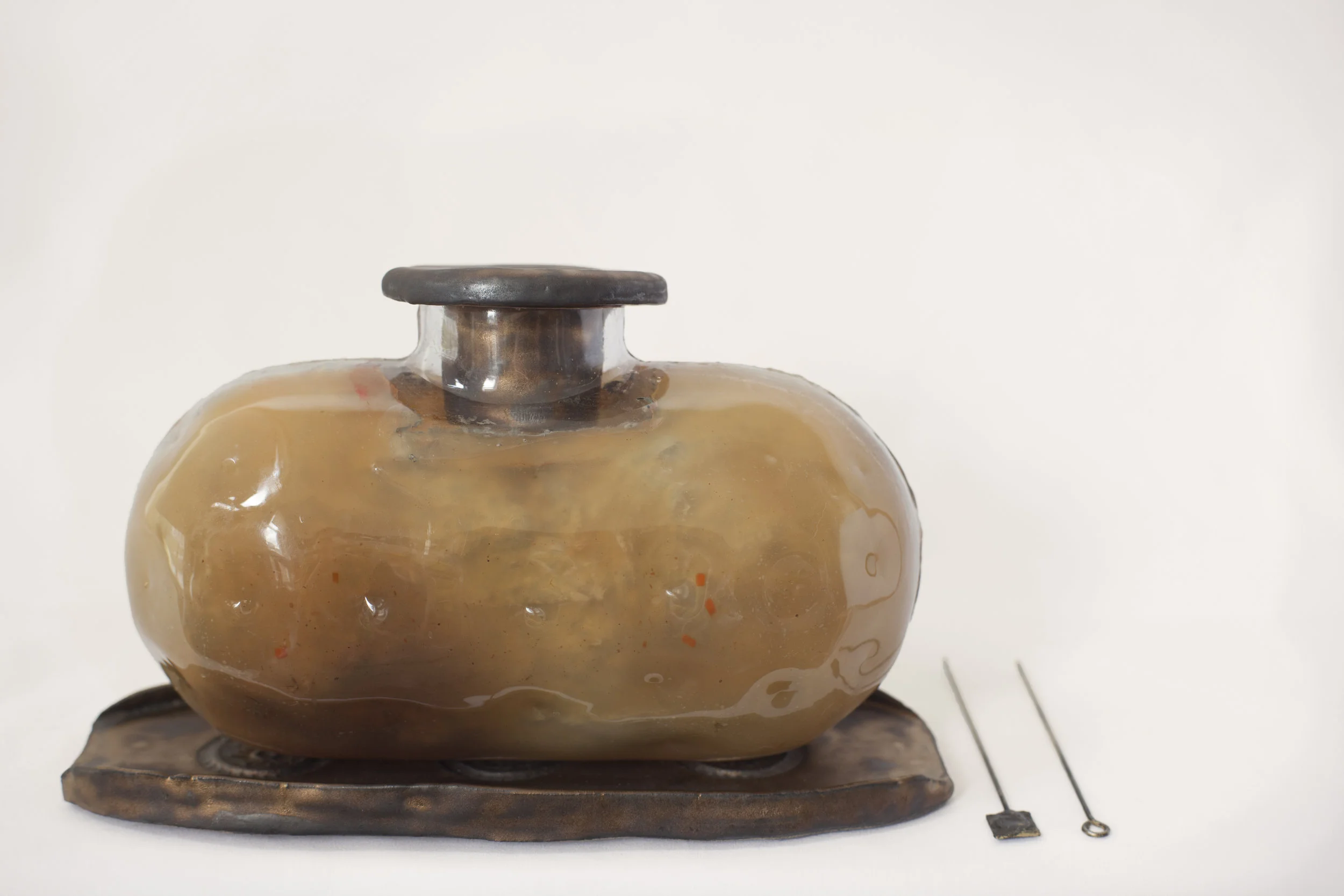
 
Microbial terrariums (c. 1703) would have been used in early 1700s to visually monitor peoples’ microbiomes and make appropriate food choices.

Microbial terrariums (c. 1703) would have been used in early 1700s to visually monitor peoples’ microbiomes and make appropriate food choices.

Cellulase (c. 1856), an enzyme harvested from cow stomachs, would be available for purchase to give humans the ability to digest cellulose as cows.

Cellulase (c. 1856), an enzyme harvested from cow stomachs, would be available for purchase to give humans the ability to digest cellulose as cows.

Blood pyramids (c. 1948) suggest a diet based on a person’s blood type.

Evolufood (c. 2038) suggests food in the future exists in a deconstructed state, giving humans the freedom to combine flavors and textures in unimaginable ways.

Evolufood (c. 2038) suggests food in the future exists in a deconstructed state, giving humans the freedom to combine flavors and textures in unimaginable ways.

Click for complete stories for each of the artifacts.

Click for complete stories for each of the artifacts.


The three historical artifacts were presented to museum visitors as parafiction, or historical reality. When the truth was revealed at the end of the exhibit, we learned that ~90% of museum visitors bought into the fiction and wondered, why didn’t history run this course?


"Microbial terrarium" is a part of a larger project named "Speculative (food) design histories" and a product of a master thesis at TU Delft by Piyali Sircar. The past is divided into four eras, each characterized by their own set of human values and principles. Piyali tampers with these values to reimagine the past and more specifically what the domain of food could have looked like. With the microbial terrarium she asks, "What if humans viewed themselves as vessels for other organisms (during the birth of Modernism)?" This video features the microbial terrarium, an object that was found in the homes of the Western upperclass in the early 18th Century. The terrarium was a platform for people to visualize their microbiomes, or the ecosystem of millions of microbes living within their guts, to make informed food choices. Microbe-watching brought families together to profile their bacteria and watch their microbial environments outside of their bodies. People even treated their microbes as pets, and felt responsible for ensuring the robustness and variety of microbes they saw. The terrarium suggests that the microbiome could have played an integral part in shaping our food habits early in history, after the discovery of the microscope. The microbial terrarium, along with its three counterparts and stories, are currently on exhibition at the Cube Design Museum in Kerkrade, Netherlands.
 
 
Cellulase is a part of a larger project named "Speculative (food) design histories" and a product of a master thesis at TU Delft by Piyali Sircar. The past is divided into four eras, each characterized by their own set of human values and principles. Piyali tampers with these values to reimagine the past and more specifically what the domain of food could have looked like. With cellulase she asks, "What if humans did not view animals as inferior beings (during the Industrial Revolution)?" Cellulase is an enzyme harvested from the rumen of cows to give humans the ability to extract up to 50% more energy from the green matter (containing cellulose) that they consume. In this alternate reality the respect humans have for animals runs deep, challenging them to look for animal utility beyond meat consumption. Humans view animals as assets to their lives, manifest in the many animal-inspired products in their world, including cellulase. This reality suggests that biophilia could have impacted designs earlier in human history. Cellulase, along with its three counterparts and stories, are currently on exhibition at the Cube Design Museum in Kerkrade, Netherlands.
 
 
Evolufood is a part of a larger project named "Speculative (food) design histories" and a product of a master thesis at TU Delft by Piyali Sircar. Evolufood imagines what food may look like in the future if our understanding of the brain reaches a level where we can synthetically elicit various sensations by manipulating the brain in a technohuman future. With Evolufood she asks, "What if humans took on the role of "God" on an even higher level?" Evolufood is a deconstruction of food into three parts: 1) a pill to meet all nutritional requirements 2) a spray that targets parts of the brain associated with tastes and smells and 3) a scaffold made of cellulose to facilitate chewing and swallowing and generate a variety of textures. There are variations of the pill depending on a person's biological goals (e.g. Want bluer eyes? Or want to be taller?) and the spray and scaffold can be combined in an infinite number of permutations and combinations to give rise to food experiences not found in the physical world. Evolufood, along with its three counterparts and stories, are currently on exhibition at the Cube Design Museum in Kerkrade, Netherlands.


PROCESS

I kicked the project off with primary and secondary research to identify major milestones in food, philosophy and science.


I sliced and diced history into four human eras I wanted to create alternate realities for. I began by mapping out the key facets of each and for each speculated, “if not this, then what?” generating ~70 “what if” scenarios.


technohead.jpg
 
 
whatif.jpg


To build my alternate realities, I facilitated six worldbuilding workshops, each designed to take participants through a series of exercises to build entire worlds around a single premise, e.g. What if humans respected animals more? or What if the human body was viewed as a vessel for other organisms? I pitched each workshop as a "Hero's Journey" to encourage participants to enter an alternate reality with new rules.


hero%27s+journey.jpg
 
 
workshopimage
 
cube.jpg
tu-delft.jpg